Wednesday, January 8, 2025

MIKE OSBORNE TRIO - Border Crossing

Border Crossing / Marcel's Muse


(Originally posted on Facebook, 3 December 2024)


Well, while I'm sitting here recovering from my operation - a.k.a. doing nothing - I might as well do some writing, give my poor left arm some purposeful exercise, so here's the third chapter in my Ogun Records survey:

 
MIKE OSBORNE TRIO: Border Crossing
(OG 300)
 
Track listing: Ken's Tune/Stop And Start/Awakening Spirit/Ist/Animation/Riff/Border Crossing
 
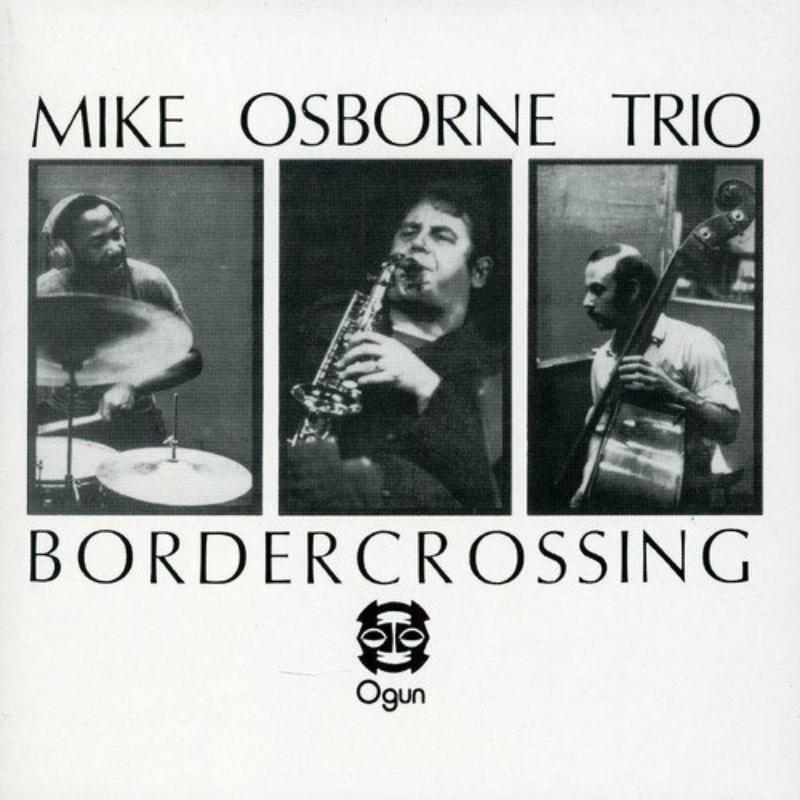
Mike Osborne (alto sax), Harry Miller (bass), Louis Moholo-Moholo (drums).
 
Recorded live at the Peanuts Club, "The King's Arms," Bishopsgate, London, 28 September 1974. Produced by Mike Osborne and Keith Beal. Sleeve design: George Hallett.
 
He might have been absent from the Brotherhood's Willisau gig, but Mike Osborne more than makes up for that in this stupendous record. In 1979's The Illustrated Encylcopaedia Of Jazz, Brian Case makes no bones about referring to Ossie as "Britain's finest alto saxophonist." It's impossible to call that title now, given the immense number of gifted altoists who have emerged onto the UK jazz scene in the subsequent forty-five years, but it's undeniable that he was one of our greatest.
 
The Trio, with Miller and Moholo-Moholo, had been in operation since 1969, but had to wait five years to be recorded. At that time Osborne was principally known as one of the star players in Mike Westbrook's various bands (of which Miller was also a member) but was in the process of realigning himself musically with the South African exiles. There is talk that his 1970 album Outback was originally intended as a Trio album but became a Quintet record after Chris McGregor and Harry Beckett were added to the line-up - some reports at the time stated that Chris and Harry simply turned up to the studio anyway, but the elaborate and thought-through arrangements of the record's tunes suggest a good deal more organisation.
 
Anyhow, the Trio enjoyed a successful long-term Friday night residency at the Peanuts Club in Bishopsgate - although they were the core band, other young horn players were often invited along to sit in and test their improvisational skills - so it was logical that their first record be recorded at one of their gigs. Border Crossing represents just forty-two or so minutes from a typical evening of blowing. In his sleevenote, Osborne states that the Trio had just returned fron a successful, if exhausting, tour of mainland Europe, with plenty of borders, both musically and physically, having been crossed. So the record could be interpreted as a declaration of intent.
 
It begins with the band's unofficial signature tune, "Ken's Tune" for Ken May, who ran the Peanuts Club. This is a charming piece which in different circumstances might pass for the theme to an animated British children's television show of the seventies (N.B.: speaking as someone who grew up watching children's television in Britain, I say that this is a good thing). It gives the Trio a chance to establish and settle into a basic post-bop groove. In a small group without any harmonic instruments, the bassist has the not inconsiderable job of both holding down the harmonic structure while simultaneously maintaining the rhythmic flow; this Miller achieves with gracious ease, allowing Moholo-Moholo to build up a steady, medium-volume percussive commentary.
 
All eases along agreeably enough, although I note Osborne's oddly sour tone and harsh-sounding reed - my father thought he made the alto sound like a soprano (and if there was one thing my father didn't like, it was the soprano saxophone). Nevertheless the Trio easily speeds up for the fast bebop of "Stop And Start," becoming more energetic. "Awakening Spirit," which is Miller's tune (Ossie wrote all the others), maintains the same optimistically forceful mood; it is one of those jaunty melodies which looks forward to what the bassist will do in Isipingo.
 
"Ist" is different. Beginning with a sonorous arco bass drone, and bells mysteriously rattling in the background - those "children at play" again, perhaps? - the alto delivers a solemn lament, a bit like Coltrane's "Alabama," before suddenly shifting into a fast klezmer march. Throughout this ten-minute performance, the three musicians eye each other up suspiciously, almost like a standoff, before breaking into exploratory features for both alto and bass. The common comparison point is Ornette's Golden Circle trio, but musically Osborne's style sounds to my ear to have much more in common with Eric Dolphy - particularly his various adventures with Mingus - than Coleman. Almost at the end of this piece, Osborne utters a terrible, guttural low-level scream through his horn, as though at the end of his tether.
 
The three tunes on side two flow into each other in an uninterrupted stream of continuous music. "Animation" sees the Trio re-establishing its post-bop framework - note how the central melody is only disclosed, and then with some reluctance, some minutes into the piece.
 
The band, prompted by Miller's bowed bass signals, then accelerate into "Riff" - a more aggressive variant of "Stop And Start" - where they reach a peak of quite terrifying intensity, all three players absolutely fired up, Osborne groping for, then achieving, full free flight, Moholo-Moholo never letting up on his rattling commentary.
 
Finally, with the title track, the Trio achieve a state of nirvana, Osborne now totally off the tonal scale, even essaying mimicry of Miller's above-the-bridge bowed scrapings as the rhythm section thunders around him. Perhaps what is most terrifying about this music is its absolute, joyful certainty. And we are not permitted to forget that we are witnessing a journey; that bebop riff is rephrased and the music fades, the players already off on their evidently unending travels...
 
Current availability: on CD and download along with OG 810 (to be reviewed), available here.

HARRY MILLER - Children At Play

Children At Play | Harry Miller


(Originally posted on Facebook, 10 November 2024)

I wasn't going to go ahead and write the next entry in my survey of Ogun Records in the light of world events last week, but after some considerable thought I came to the conclusion that the writing needed to go on, even if it only forms an additional sail to my tiny tugboat of resistance. So here goes:
 
HARRY MILLER: Children At Play
(OG 200)
 
Track listing: H And H/Children At Play (Phase I And II)/Homeboy/Foregone Conclusion/Children At Play (Phase III)
 
Harry Miller (multitracked double bass, flute on "Homeboy" and "percussion effects")
 
Recorded in Hastings, 1974; produced and mixed by Keith Beal 
 
As the co-founder and co-owner of Ogun Records, it was only right and fair that Harry Miller should have an album all to himself. A fairly important album, too, since it set the scene for Miller's composing and arranging abilities.
 
Miller had hitherto been known as a highly respected bassist, playing a key supporting and prompting role in the various bands of Mike Westbrook, Chris McGregor, Bob Downes, Mike Osborne and others, as well as ventures outside the realm of jazz in his work with Mike Cooper and King Crimson. But he had not been known as a composer or bandleader in his own right.
 
Children At Play was quite a striking departure. Solo albums by jazz bassists were at the time exceptionally rare; in fact, I can only think of Barre Phillips' Unaccompanied Barre from 1969. Other solo recitals by Barry Guy and Dave Holland would follow later in the seventies (interestingly, all three of these musicians worked successfully with Miller as half of a two-bass set-up in various settings).
 
But Children At Play is not an improvised (or indeed written) solo recital. Instead, Miller used the occasion as an opportunity to experiment. There are multitracked basses, usually two and sometimes three in number, deployed in highly organised arrangements.
 
The album seems to have been recorded at Ogun co-owner Keith Beal's home studio in Hastings. I remember a Melody Maker interview where Miller spoke about Beal's house being literally situated on the edge of a cliff, exposed to rather vicious winds from the sea, and there is certainly something of the dark and stormy night about the thirty-six-or-so minutes of music here.
 
The record begins agreeably enough with the funky jam "H And H" (which I have always assumed stands for Hazel and Harry). Miller hits a compelling groove and throws in some of those "percussion effects" with excellent results (the cowbell is the key factor here). Somebody really ought to sample this.
 
The first two "phases" of the title track handle the main melody on pizzicato and arco bass(es) respectively. The first section is indeed quite playful, Miller audibly enjoying scampering around the upper notes (below the bridge) like a happy kitten. But the second section is more sombre in mood - a useful comparison here would be Miller and Phillips' bowed bass duet on Westbrook's "Landscape" from Marching Song, a work mostly inspired by the then-recent canonisation of World War I. Set at the dawn of battle, one is reminded that 1914 was also the time when the Viennese school of composers really began to make their mark; there's quite a touch of Alban Berg's Lyric Suite about the proceedings - and less comforting.
 
Then the clouds break and we meet the album's happiest moment, the old-school kwela workout of "Home Boy" with Miller's basses thumping out the rhythm and skittering around the tune's borders. Miller takes to the flute to carry the main melody, and although his flute playing clearly wasn't going to give Bob Downes any sleepless nights, its nostalgic naivety is reassuring; if anything, he appears to be blowing the flute in the manner of a penny whistle, rekindling the memory of Spokes Mashiyane, Kippie Moeketsi and others.
 
Side two opens with the album's big setpiece, "Foregone Conclusion" - and one can certainly palpate the rattling of metaphorical chains and the aura of ghosts in the air. The house feels dark and not quite empty. The tone of the piece is austere and rather unforgiving and some listeners may detect a Mahlerian heaviness.
 
Yet what this extended piece does is remind us that there are evil spirits in this environment, or more correctly the environment from which Miller and his fellow South African musicians had fled - one of midnight home visits and distantly-felt beatings. That pulse is never really absent from what is otherwise a fairly uncompromising, yet utterly heartfelt, composition. If you listen closely enough you may even discern the winds howling outside the house's windows.
 
The record concludes with a mournful and poignant reprise and extension of the "Children At Play" theme. In ways it does remind me of the equally unapologetic political works of Charlie Haden, but Miller engaged a significant figure to write the sleevenote - Zweledinga Pallo Jordan, then on the National Executive of the African National Congress, later an ANC MP and Cabinet Minister.
 
In it, Jordan speaks of Miller's art as being "expressive of a cultural recycling" in the sense of jazz and improvised music being reclaimed and revitalised by the roots from which it had first sprung. Listening to this album, one is also very regrettably reminded, in this week of all weeks, that Miller might have been thinking of metaphorical children - repressive, infantile politicians, playing with people's lives and indeed the world, to unspeakable effect.
 
Current availability: Reissued on CD as part of The Collection in 1999; although that is long out of print, the album is now available as a download here.

CHRIS McGREGOR'S BROTHERHOOD OF BREATH - Live At Willisau


(Originally published on Facebook, 31 October 2024)


Well, since I'm new here - and, once again, many thanks for letting me in! - I thought it would be a nice idea to do an ongoing, chronological look at what is still after some 46 years of buying their records still my favourite label - Ogun Records. I did a similar exercise on one of my blogs (sorry, can't remember which one) more than twenty years ago but I think it now needs expanding and refining. The views represent my gut reactions to the music and are not intended to reflect any others, but if I get anything wrong I'm sure you'll correct me.
 
Anyway, enough of the preamble and on to the first Ogun record:
 
CHRIS McGREGOR'S BROTHERHOOD OF BREATH - Live At Willisau
(OG 100)
 
Track listing:
Do It/Restless/Kongi's Theme/Tungi's Song/Ismite Is Might/The Serpent's Kindly Eye
 
Musicians:
Chris McGregor (piano), Mongezi Feza, Harry Beckett, Mark Charig (trumpets), Nick Evans, Radu Malfatti (trombones), Dudu Pukwana (alto sax), Evan Parker, Gary Windo (tenor saxes), Harry Miller (bass), Louis Moholo-Moholo (drums).
 
Recorded at the Willisau Jazz Festival, Switzerland, on 27 January 1973 (two days after my ninth birthday!) by Roland Janz and remixed in London by Keith Beal. Cover design by Niklaus Troxler.
 
I think this album came out around September 1974, although I didn't buy it until late 1978, from Listen Records in Renfield Street, Glasgow. Boy did it blow my teenage post-punk socks off. In many ways it felt like a punk record, or at least a punk-jazz record. I heard (and saw) what The Pop Group and The Slits did just months later and knew I wasn't the only one affected.
 
As I understand things, Hazel and Harry Miller had this live tape of the Brotherhood that they couldn't sell. The band had come to the end of their two-album RCA contract and nobody seemed much interested in putting the tape out. Those few years when the New Thing was trendy and/or a tax loss for major record companies were spent, so the Millers had no alternative but to set up their own label - as Derek Bailey, Evan Parker and Tony Oxley had already done with Incus - in order to get the music out there.
 
At the time they ran the label from a third-floor tower block flat in Stockwell and since the lift was frequently out of order many an exhausting time was spent hauling heavy boxes of records up and down the stairs - and that's saying nothing about Harry having to do the same thing with his own double bass.
Still, the effort was, I think, worth it. Live At Willisau really does bear the feeling of a samizdat tape, smuggled out from behind the border. Its recording quality is less than hi-fi, to put it diplomatically, but somehow that adds to the urgency of the band's performance.
 
I've heard tell that the album was essentially taped on a very basic tape machine - possibly even a cassette recorder - and I would guess that the machine and/or microphone was/were placed somewhere in the trombone section, since you can hear crystal clear everything that Nick Evans and Radu Malfatti do, while the trumpets and to a lesser extent the saxophones tend to become a blur of sound in the collective passages.
 
This was an uncompromising edition of the Brotherhood. Comparatively straightforward players like Alan Skidmore and Malcolm Griffiths were replaced by the returning Evan Parker (he had been there right at the beginning of the Brotherhood, but spent most of the intervening two years working on Incus and Incus-related projects and/or on the Continent, principally in Germany) and the hitherto unknown Radu Malfatti. Furthermore regular second altoist Mike Osborne was absent from this gig, presumably for health reasons - so a freer approach to the music is immediately evident.
 
The opening "Do It" already sounded pretty free on the second studio BoB album. Announced by a startling fanfare of screeching brass and monolithic reeds, the band settles into the tune's two powerful riffs and it is instantly evident how crucial Miller and Moholo-Moholo are to holding the whole enterprise together; their solidity allows and frames the adventures.
 
Evan Parker takes the main solo and starts it pretty conventionally - even sounding like Tubby Hayes at times - before gradually moving out into the free zone, prompted and pushed by the rhythm section. Say what you like about his recent idiotic political comments, but as a saxophonist he is - or at any rate was - quite sensational. As he becomes more abstract, the rest of the horns roar up behind and beside him.
The music atomises and both trombonists take over the main commentary while the band improvises more and more frantically around them, but without ever losing the central riffs or any of their power. Moholo-Moholo finally coaxes them into a final thematic statement then builds up the tension until a joyous free explosion is swiftly succeeded by a fatigued slowing-down.
 
"Restless" is a fast-tempo fragment of small-group interaction where McGregor, Dudu Pukwana and the rhythm play cat-and-mouse games similar to those played by Cecil Taylor, Jimmy Lyons and Sunny Murray at the Café Montmartre a decade before. This immediately segues into "Kongi's Theme," one of those marching band pieces in which Archie Shepp used to indulge in the sixties, which features a laconic and perhaps sardonic Radu Malfatti, fearlessly expanding the trombone's vocabulary (a bit like a slightly more supercharged Paul Rutherford).
 
"Tungi's Song" is a lovely lilt of a tune which spotlights Mongezi Feza in what I think is his best solo on record. Obviously, had he lived, Mongs would very much have become a core member of the Ogun family, and who knows where he could have gone? Here he is emerging out of his Don Cherry influences and establishing a more confident and individual voice for himself - although his solo is accompanied or echoed by what sounds like one of those octave-divider devices of which players like Don Ellis were so fond.
 
"Ismite Is Might" is a slow and stately ballad feature for Nick Evans, who digs right into his Welsh Baptist roots and plays a soulful but forthright solo fully worthy of Roswell Rudd. Finally "The Serpent's Kindly Eye" brings the band back to the boil; Dudu Pukwana and Mark Charig are the main palpable soloists, but soon everyone is joining in the mêlée before a sudden and decisive ending.
 
Current availability: the album reappeared on CD in 1994 (cat no: OGCD 001) with sleevenotes by Val Wilmer and half an hour of extra material. Of the latter, "Camel Dance" is a feature for Harry Beckett (whom we didn't get to hear as a soloist on the original record) and "Davashe's Dream" (the source of the opening crashing chords to "Do It"), "Andromeda" and "Union Special" are all reworkings of tracks on the first BoB album.
 
At times you can tell why these were left off the original - the ensemble playing occasionally gets too sloppy (an audibly exasperated McGregor presses down on his keyboard to prompt the horns on "Andromeda," who seem to have got lost - at least two of these musicians subsequently confirmed to me that, erm, certain substances may have been in evidence) although Feza and Evans' solos are noticeably more straight-ahead than they were on the studio recording) but the excitement of the music does not really relent, and the closing "Funky Boots March" (a co-write for Evans and Gary Windo, the latter being the only player from whom we don't really get to hear at all) is a fine, to-hell-with-you-squares finale (you tend to forget that the Brotherhood bore a finely-honed sense of humour).
 
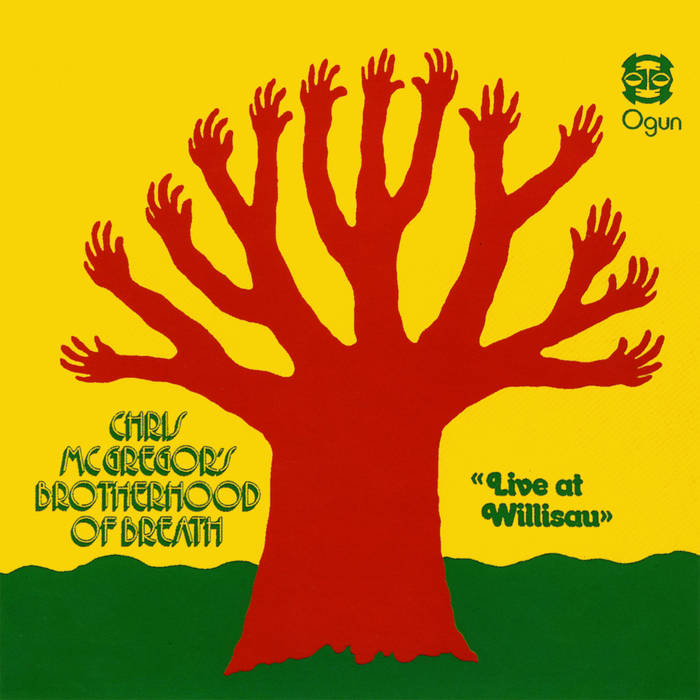
Overall this is one of the great Ogun albums, and a fine introduction to what proved to be a uniquely inventive and passionate body of work. As a boy I also appreciated Mr Troxler's simple-seeming but actually very astute primary-coloured sleeve designs - kids are attracted to anything colourful. If you want to buy this album then please go here.

INTRODUCTION

Ogun Recordings


The purpose of this blog is to review every album that has been released by my favourite record label, Ogun Records. I was an eager consumer of their albums as a teenager in the seventies and still harbour a profound love for the explosively passionate music that they have released.


I recently began to post reviews of each chronological Ogun album release for the Jazz Exiles.. /South African/ Caribbean Jazz group on Facebook. However, the changes currently proposed for Facebook by its management go violently against all of my principles as a human being so I'm going to republish what I have already posted there on this blog, then add new entries as I go along. I will try to maintain reasonably regular updates but do have a lot of other commitments, so your patience is appreciated. I will also be enabling comments here for the good people at Facebook - there are still some - but if any troll or spammer takes advantage of that, the facility will be discontinued immediately and without ceremony. I'm really hoping that doesn't happen because it isn't what this blog is supposed to be about. Anyway, I trust you will enjoy this incrementally-advancing history of a thoroughly incredible and mould-breaking record label.

LOUIS MOHOLO-MOHOLO OCTET - Spirits Rejoice!

    (OG 520)   Track listing: Khanya Akha Ukhona (Shine Wherever You Are)/You Ain’t Gonna Know Me ‘Cos You Think You Know Me/Ithi-Gqi (Appea...